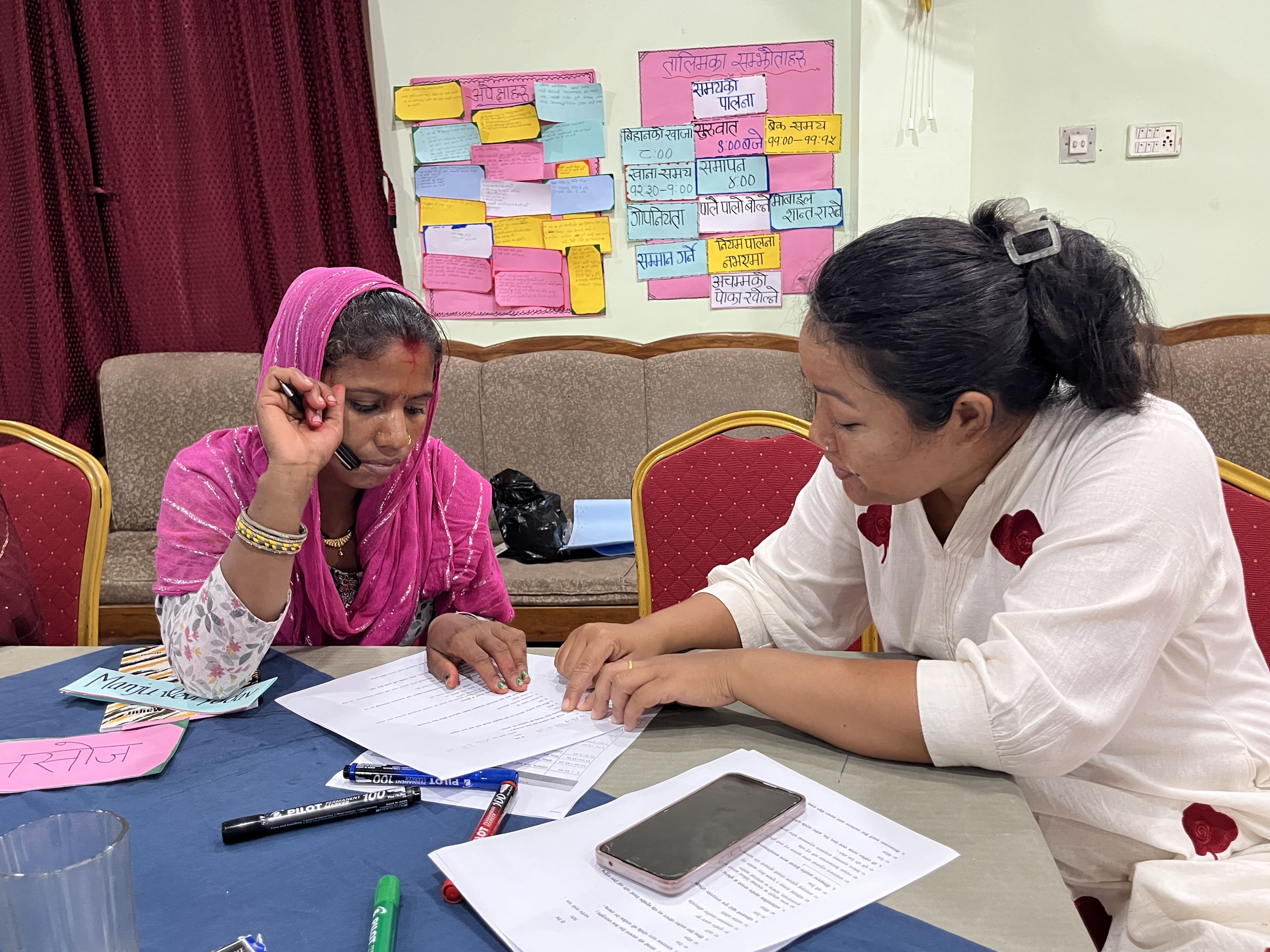
The project seeks to build resilience in vulnerable communities of Durga Bhagwati Rural Municipality and Rajdevi Municipality by strengthening forecasting, early warning systems, and preparatory actions under women’s leadership. It enhances the capacity of women and women-led organizations, selects and trains disaster response volunteers, and promotes women’s leadership in anticipatory mechanisms. The initiative also raises awareness among government decision-makers and gender-based violence service providers to integrate inclusive early warning actions while advocating for resource utilization. This effort fosters inclusive disaster preparedness and sustainable resilience through gender-sensitive collaboration.
Details in Bullet:
Objectives
Establishing and strengthening women-led early warning and action mechanisms in Durga Bhagwati Rural Municipality and Raj Devi Municipality.
Promoting women’s leadership in community-level CDMCs.
Enhancing the first responder capacity.
Advocate and lobby with government decision-makers to secure resources for women-led early warning actions.
Leveraging Humanitarian Partnership platform (HPP) to ensuring meaningful participation of women and girls in existing anticipatory action efforts across Nepal in Sudurpaschim and Lumbini province
Key Components and Scope of Work
A. Women-led Anticipatory Action Systems
Risk Profiling & Multi-Hazard Assessment: Community-based assessments led by CDMCs, WLOs, and women leaders.
CDMC Strengthening: Reform CDMCs to ensure women's representation; build leadership capacity; map social norms and barriers.
Action Planning: Develop EW plans, conduct community consultations, and promote local early actions.
Awareness & Dissemination: Conduct campaigns and support risk message delivery through formal and informal channels.
Monitoring & Learning: Conduct After Action Reviews (AAR) and document learnings for replication.
B. First Responder Capacity Building
Training: Deliver training on first aid, CADRE, GBViE, psychosocial support, and humanitarian standards.
Simulation & Coordination: Facilitate simulations and Bipad Chautaris for multi-stakeholder engagement.
Service Mapping: Identify GBV and emergency service providers and strengthen referral systems.
C. Women’s Leadership in Anticipatory Action (AA) via HPP
Capacity Development: Train HPP members on women-led AA.
Participation Audits: Evaluate current AA initiatives and integrate project learnings.
Policy Influence: Recommend inclusive practices and advocate for policy recognition of women-led AA models.
D. Advocacy and Government Engagement
SOPs & Frameworks: Develop localized SOPs and communication protocols for CDMCs and EWEA task teams.
Coordination & Simulations: Promote inter-municipal drills under DDMC/DEOC leadership.
Climate & Policy Integration: Collaborate with Department of Hydrology and Meteorology to establish climate stations; localize MIS portals; push for investments in gender-responsive AA.
Resource Mobilization: Leverage local budgets for risk-informed structural and non-structural mitigation.
Expected Outcomes
Functional, women-led Early Warning and Early Action (EW/EA) systems established and operationalized in Durga Bhagwati and Raj Devi Municipalities
Increased representation and capacity of women in DRM structures.
Strengthened coordination mechanisms among stakeholders for disaster risk reduction and climate change adaptation at the local level.
Policy and institutional shifts in favor of inclusive disaster governance.
Media Link/Coverage: Disaster training,Training
The project is implemented in partnership with:
- Campaign Nepal
It also collaborates closely with local governments, community institutions, and national stakeholders to ensure sustainability, scalability, and policy integration.