IRDR International Centre of Excellence

Interdisciplinary Research on Himalayan Risk and Resilience

IRDR ICoE‑IHRR

A regional and global hub advancing interdisciplinary science, innovation and action for disaster risk reduction in the Himalayan region and beyond.

Host: Institute of Himalayan Risk Reduction [email protected]
The Designation

IHRR joins the global IRDR International Centre of Excellence

The Integrated Research on Disaster Risk programme is co-sponsored by the International Science Council and the United Nations Office for Disaster Risk Reduction. IRDR International Centres of Excellence are established to make direct contributions to the programme's missions, particularly through research, capacity development and international collaboration.

On 29 July 2026, IRDR officially announced the designation of six new International Centres of Excellence following its 2026 call for expressions of interest and a three-stage evaluation process undertaken by the IRDR International Programme Office and Scientific Committee. The new centres expand the geographic and thematic reach of the IRDR network and strengthen its capacity to mobilize science for disaster risk reduction, resilience and sustainable development. Among the newly designated centres is the IRDR International Centre of Excellence on Interdisciplinary Research on Himalayan Risk and Resilience, IRDR ICoE-IHRR, hosted by the Institute of Himalayan Risk Reduction in Nepal.

The official IRDR announcement particularly recognizes IHRR's experience in citizen science, community-based disaster risk reduction, multi-hazard risk assessment and operational early warning systems addressing hazards such as drought and heat–cold waves.
Integrated Research on Disaster Risk (IRDR) logo

The IRDR programme is co-sponsored by:

  • International Science Council
  • UN Office for Disaster Risk Reduction
Visit the IRDR ICoE community
Vision

Vision of the IRDR ICoE-IHRR

To serve as a regional and global hub of excellence that advances interdisciplinary science, innovation, and action for disaster risk reduction in the Himalayan region and beyond.

The Centre will integrate natural sciences, engineering, technology, social sciences, and policy research to address multi-hazard, cascading, and transboundary risks, while directly contributing to IRDR's mission and Research Framework on Risk-informed Sustainable Development and Planetary Health.

IRDR ICoE-IHRR will connect natural sciences, engineering, technology, social sciences, public health and policy research to address multi-hazard, cascading, compound and transboundary risks. The Centre will also promote open science, citizen science, anticipatory action, frontier technologies, capacity development and stronger connections between science, policy and practice.

Objectives

A visible Himalayan platform for

Following the inauguration, IRDR ICoE-IHRR will work toward becoming a visible Himalayan platform across nine priority areas.

01
Interdisciplinary disaster risk research
02
Multi-hazard, cascading and transboundary risk assessment
03
Citizen science and community-based monitoring
04
Early warning systems and anticipatory action
05
Frontier technologies and open-data applications
06
Planetary health and climate resilience
07
Fellowships, field schools and visiting scholar programmes
08
Policy briefs and science–policy dialogues
09
Regional research partnerships and international knowledge exchange

Through these activities, the Centre will seek to translate scientific evidence into practical tools, policies and community-level actions while strengthening the next generation of disaster risk researchers and practitioners.

Roadmap

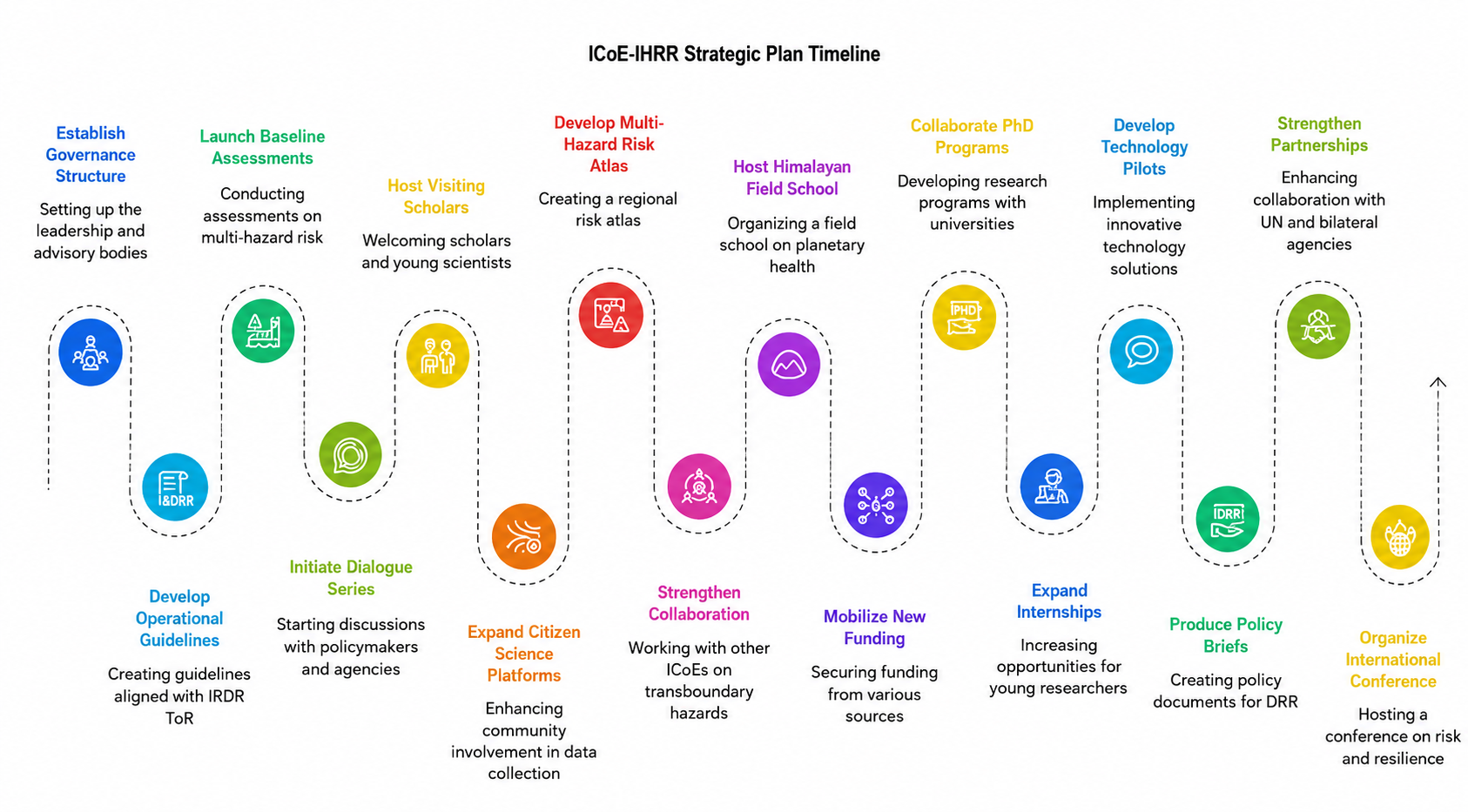
Strategic Plan Timeline

From establishing governance structures to hosting an international conference on risk and resilience — the sequence of actions the Centre will take forward.

ICoE-IHRR Strategic Plan Timeline: establish governance structure, develop operational guidelines, launch baseline assessments, initiate dialogue series, host visiting scholars, expand citizen science platforms, develop multi-hazard risk atlas, strengthen collaboration, host Himalayan field school, mobilize new funding, collaborate on PhD programs, expand internships, develop technology pilots, produce policy briefs, strengthen partnerships and organize an international conference

Swipe to view the full timeline →

Partnerships

Strategic partnerships and open science

ICoE-IHRR will build and strengthen strategic partnerships with diverse stakeholders including UN agencies, governments, and DRR organisations at national, regional, and international levels. It will also collaborate with the National Platform for Disaster Risk Reduction (NPDRR) of Nepal and the apex body of Nepal, i.e. the National Disaster Risk Reduction and Management Authority, and contribute to support on developing policy briefs and strategic key actions.

The Centre will also function as a regional hub for open science and decision support, disseminating research outputs, promoting open data, and nurturing the next generation of DRR leaders through field schools, learning labs, Fellowships, Mapathon, Hackathon, Open data, Crowdsourcing and Citizen Science initiatives. By doing so, ICoE-IHRR will strengthen the science–policy–practice interface and contribute to the implementation of the Sendai Framework, the 2030 Agenda, the Paris Agreement, and IRDR's Research Framework, positioning itself as a visible regional centre of excellence for resilience and planetary health.

Sendai Framework 2030 Agenda Paris Agreement IRDR Research Framework
Governance

How the Centre operates

IRDR ICoE-IHRR will function independently under the guidance of the IRDR Scientific Committee, while working closely with National Committees and the International Programme Office. The Centre will also communicate, collaborate and explore research dimensions with the IRDR Young Scientists working actively in Nepal and beyond. Further, it will adopt a localized-yet-global approach, bringing together local innovators, researchers, citizen scientists and practitioners with an international cohort of visiting scholars and young scientists.

Leadership

Led by the Executive Director of IHRR.

Support Structure

Supported by a Secretariat and a Scientific Advisory Board.

Sustainability

Sustained through IHRR as host organization and through partnerships.

Through this vision, ICoE-IHRR will advance open science, collaborative research, and evidence-based decision-making, thereby emerging as a visible centre for knowledge, capacity building, and policy engagement, strengthening partnerships with UN agencies, international networks, and local communities.

Event

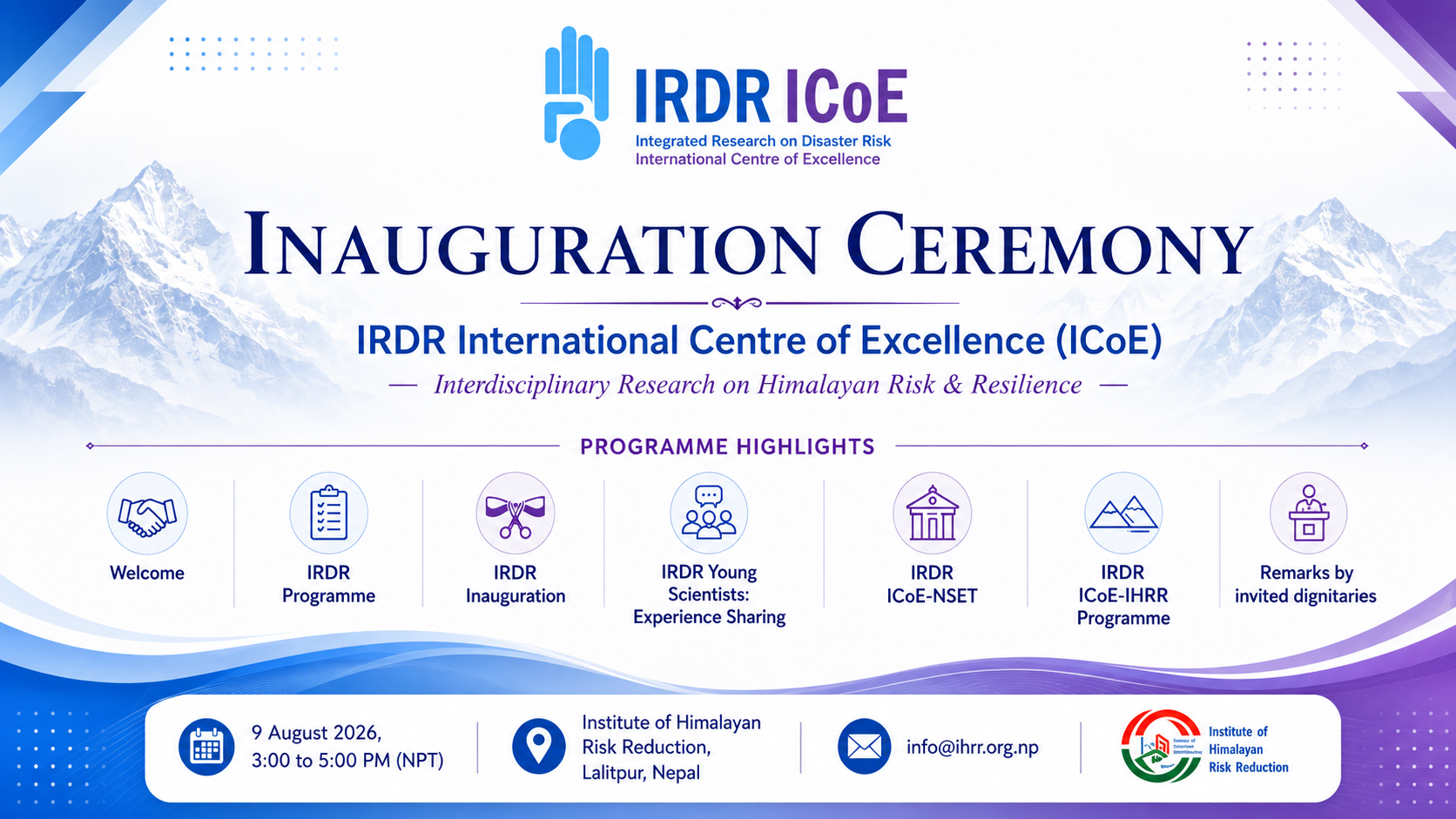
Inauguration Ceremony

The formal launch of the IRDR International Centre of Excellence on Interdisciplinary Research on Himalayan Risk and Resilience.

Date & Time 9 August 2026, 3:00–5:00 PM (NPT)
Venue IHRR Office, Mahabir Marga S, Kupondole, Lalitpur
Participation By invitation only · 30–50 participants

Indicative Programme Flow

Time Programme
3:00–3:20 PM Registration, arrival and informal interaction
3:20–3:25 PM Welcome and opening
3:25–3:32 PM Overview of the IRDR programme and ICoE network
3:32–3:37 PM Formal inauguration of IRDR ICoE-IHRR
3:37–3:47 PM Experience sharing by IRDR Young Scientists from Nepal
3:47–3:55 PM IRDR ICoE-NSET: reflections, experiences and collaborative opportunities
3:55–4:05 PM Presentation of the IRDR ICoE-IHRR vision and programme
4:05–4:25 PM Remarks from invited dignitaries
4:25–4:30 PM Closing remarks and vote of thanks
4:30–5:00 PM Group photograph, media interaction, networking and refreshments
Document

Concept Note

Full concept note for the inauguration ceremony — background, purpose, objectives, proposed participants, programme flow and expected outputs.

Concept Note (PDF)

Inauguration Ceremony of the IRDR ICoE-IHRR

Get in touch with the Centre

For collaboration, partnership or media enquiries related to the IRDR ICoE-IHRR, please reach out to the Institute of Himalayan Risk Reduction.

Contact Focal Person
Er. Suraj Gautam

Executive Director
Institute of Himalayan Risk Reduction, Lalitpur, Nepal