Bagmati River Basin-Level Simulation Exercise Strengthens Flood Preparedness and Institutional Coordination
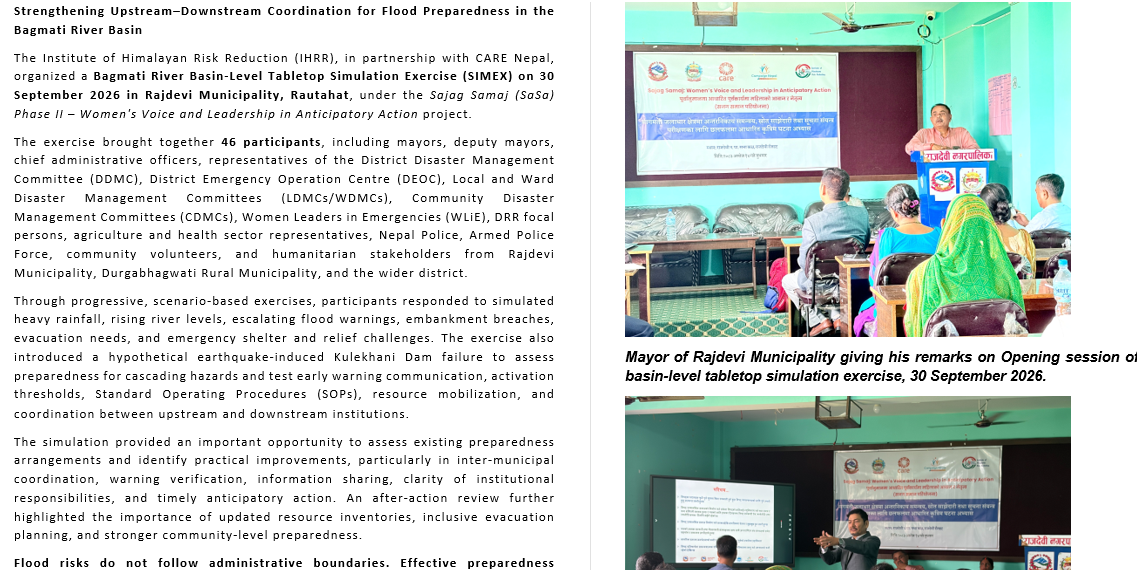
The Institute of Himalayan Risk Reduction (IHRR), in partnership with CARE Nepal, organized a Bagmati River Basin-Level Simulation Exercise (SIMEX) from 29 September to 1 October 2026 in Rautahat District, Madhesh Province, under the Sajag Samaj (SaSa) Project. The exercise aimed to test the effectiveness of existing disaster preparedness plans, Standard Operating Procedures (SOPs), early warning systems, anticipatory actions, and coordination mechanisms across different levels of governance.
The exercise brought together representatives from the District Disaster Management Committee (DDMC), District Emergency Operation Centre (DEOC), Rajdevi Municipality, Durgabhagwati Rural Municipality, Ward Disaster Management Committees (WDMCs), Community Disaster Management Committees (CDMCs), Nepal Police, Armed Police Force, local volunteers, women's groups, Dalit community representatives, and other humanitarian and civil society stakeholders. The participation of district, municipal, ward, and community-level institutions provided an opportunity to assess coordination and information-sharing across administrative boundaries.
Using progressive, scenario-based injects, the simulation examined responses to heavy rainfall forecasts, rising river levels, potential dam failure, embankment breaches, widespread inundation, evacuation requirements, displacement, and humanitarian needs. Participants tested early warning dissemination, activation of thresholds and triggers, emergency communication, evacuation decision-making, resource mobilization, and coordination between upstream and downstream institutions.
The exercise demonstrated strengths in vertical coordination between local and district-level emergency mechanisms and highlighted the important role of ward and community structures in last-mile warning dissemination and response. The After-Action Review also identified areas requiring improvement, including incomplete resource inventories, unclear activation authority for anticipatory actions, inconsistent warning acknowledgement and documentation, and limited horizontal coordination and resource-sharing between municipalities.
The findings emphasized the need for clearer institutional responsibilities, updated resource mapping, stronger inter-municipal coordination, improved communication protocols, inclusive evacuation planning, and regular simulation exercises to strengthen preparedness.
Through the Sajag Samaj Project, IHRR continues to promote community-centred disaster risk reduction, inclusive early warning systems, anticipatory action, and stronger institutional coordination to enhance flood resilience across the Bagmati River Basin.