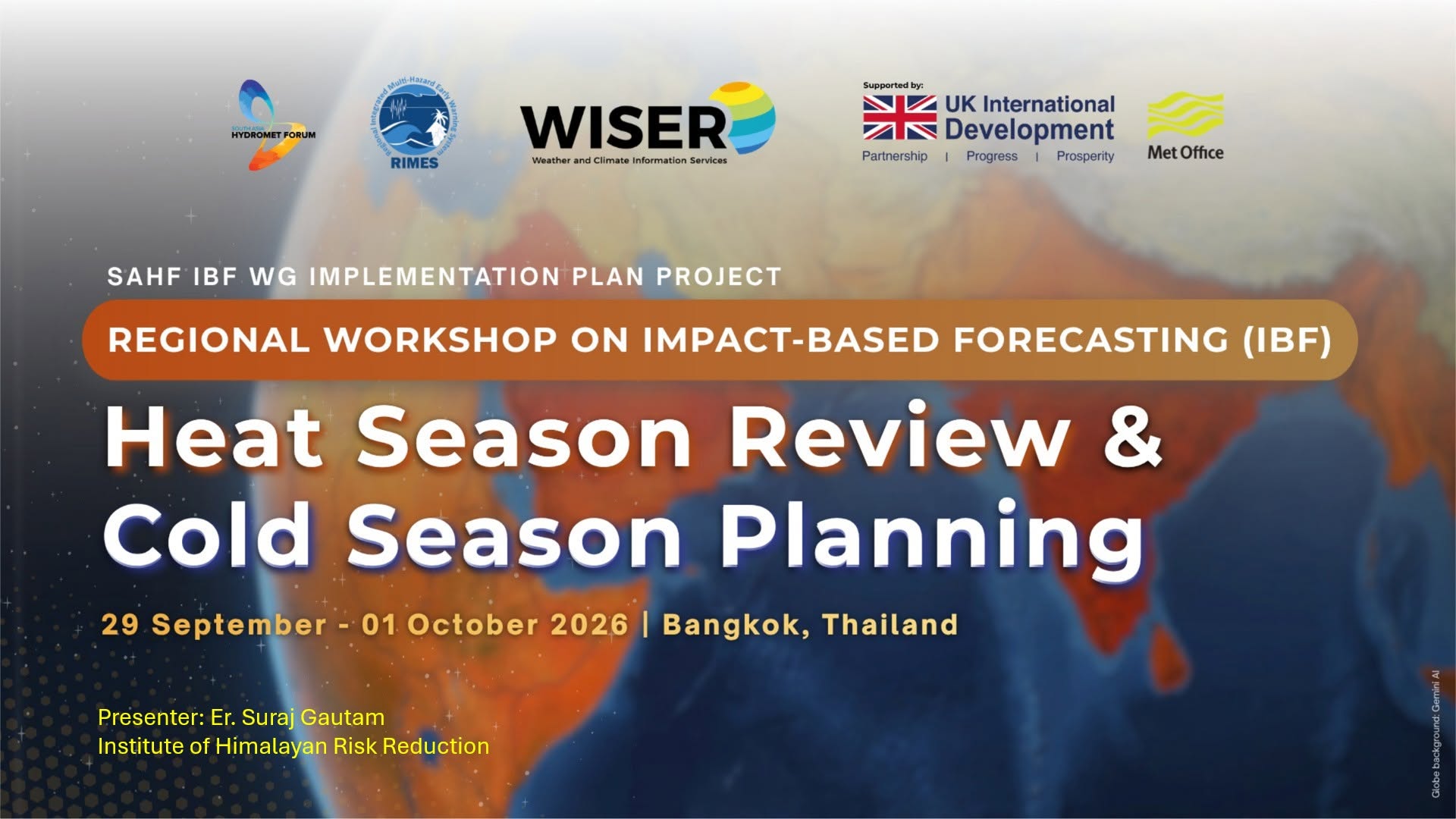

29 September – 1 October 2026 | Bangkok, Thailand
The Institute of Himalayan Risk Reduction (IHRR) contributed to the South Asia Hydromet Forum (SAHF) Regional Workshop on Impact-Based Forecasting: Heat Season Review and Cold Season Planning, held from 29 September to 1 October 2026 in Bangkok, Thailand. The workshop was organized under the SAHF Impact-Based Forecasting initiative, implemented by the Regional Integrated Multi-Hazard Early Warning System for Africa and Asia (RIMES) and the UK Met Office, with support from the WISER Asia Pacific Programme.
Er. Suraj Gautam, Executive Director of IHRR, delivered a virtual presentation titled “Cold Wave Anticipatory Action and Impact-Based Forecasting in Nepal: Lessons Learned, Good Practices, and Future Considerations.”
The presentation highlighted Nepal’s experiences in monitoring cold-wave impacts, advancing impact-based forecasting (IBF), and linking weather information with anticipatory actions to protect vulnerable communities.
Unlike heat waves, cold waves present distinct challenges in defining thresholds, monitoring localized impacts, and understanding how temperature, exposure, housing conditions, and socioeconomic vulnerabilities influence risks. The discussion emphasized the importance of moving beyond meteorological thresholds towards impact-oriented monitoring and locally appropriate early warning systems.
Translating Ground-Level Evidence into Anticipatory Action
In collaboration with CARE Nepal, IHRR has been working to collect and monitor ground-level impacts of cold waves, contributing to a better understanding of how cold-related hazards affect communities.
Experiences and lessons from the 2025 cold season are helping inform IHRR’s priorities for winter 2026/27, particularly in strengthening impact monitoring, community engagement, early warning communication, and anticipatory action.
Strengthening Regional Collaboration
The three-day regional workshop brought together national meteorological and hydrological services, disaster management practitioners, technical experts, and development partners from South Asia to exchange experiences, review heat-season demonstrations, and develop plans for the upcoming cold season.
The workshop also provided an opportunity to discuss the institutionalization and sustainability of impact-based forecasting approaches across the region.
IHRR extends its appreciation to RIMES, the UK Met Office, and regional partners for facilitating knowledge exchange and strengthening collaboration on climate-informed early warning and anticipatory action.
IHRR remains committed to translating weather forecasts into actionable risk information, strengthening community-level preparedness, and advancing people-centred early warning systems in Nepal.